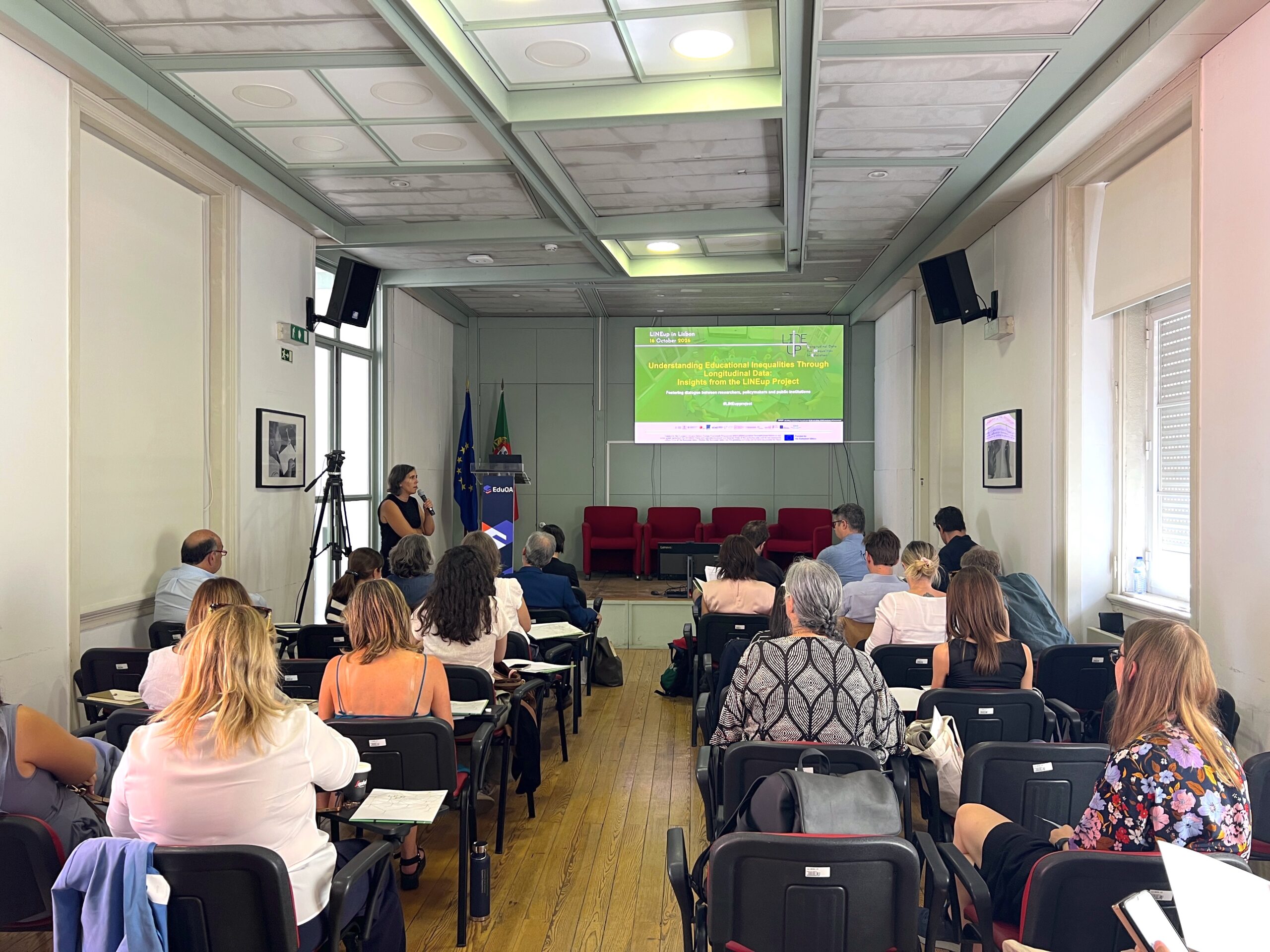


From 1 to 4 September 2026, the IV International Conference of Scuola Democratica brought together around 1,500 researchers and practitioners at Sapienza University of Rome to discuss some of the key challenges facing education systems today.
As part of the conference, Fondazione per la Scuola, coordinator of the Horizon Europe LINEup project, organised the panel “Tracing Inequalities to Foster Democratic Education: The Value of Longitudinal Data”, convened by Veronica Mobilio, Gianluca Argentin and Ilaria Lievore.
Why “tracing” inequalities matters
The panel started from a simple premise: educational inequalities cannot be fully understood by looking at a single point in time. Gaps emerge and develop through educational trajectories. They may widen, persist or narrow, while the mechanisms driving them can change at different stages of students’ educational careers. Understanding these processes requires evidence that follows students, schools and education systems over time.
This is also one of the central ideas behind LINEup. By mapping longitudinal education data across Europe and examining how they can be used to study educational inequalities, the project has highlighted both the potential of existing data and the need to move from simply identifying gaps to understanding when they emerge, how they evolve and which mechanisms contribute to their persistence or reduction.
The panel therefore brought the LINEup perspective into a broader research conversation, asking one overarching question: What does looking at inequalities over time allow us to see that we would otherwise miss?
Different perspectives on inequalities over time
The contributions approached this question from very different angles, illustrating the range of issues that can be explored when a temporal or longitudinal perspective is brought into the study of educational inequalities.
Several presentations examined the COVID-19 pandemic as a critical disruption in educational trajectories. They explored changes in cognitive and non-cognitive outcomes, the widening of inequalities between more and less advantaged students, and the ways in which the pandemic may have affected educational choices at crucial transition points. Taken together, these contributions showed why the effects of a major shock cannot be captured only through average changes in achievement: understanding who was most affected, and how existing inequalities changed, requires looking at trajectories before, during and after the disruption.
Other contributions focused on the mechanisms operating within schools and classrooms. These included the role of peer achievement and socioeconomic classroom composition in shaping subsequent educational choices, highlighting how students’ trajectories are influenced not only by their individual and family characteristics but also by the social environments in which learning takes place.
A further set of contributions moved from individual trajectories to the institutional rules and structures that shape inequality. Comparative analyses examined how school admission criteria have changed across countries and how these rules may contribute to socioeconomic segregation. Other work focused on school dropout, showing how fragmented data systems across institutions can make it difficult to follow students over time and identify emerging risks early enough to intervene.
The discussion also extended beyond the availability of longitudinal data to their use and interpretation. Contributions on monitoring and student voice highlighted that collecting evidence over time is only one part of the process: data acquire value when schools, institutions and communities are able to interpret them collectively and translate them into action.
From longitudinal data to educational action
Despite their different topics, data and methodological approaches, the contributions converged on an important point: time matters for understanding educational inequality.
Cross-sectional evidence can show that a gap exists. Longitudinal evidence can help reveal when it emerged, whether it is widening or narrowing, which transitions or contextual changes matter, and which mechanisms may be driving it.
This distinction is central to LINEup. The ambition of the project is not simply to promote greater availability of longitudinal education data across Europe, but to strengthen their capacity to generate knowledge that can inform more timely and equitable educational policies.
The Scuola Democratica panel provided a valuable opportunity to bring this perspective into dialogue with a diverse range of research and approaches — and to continue the conversation on how tracing inequalities over time can help move from documenting educational disparities to understanding, and ultimately addressing, the processes that produce them.