

July 16, 2026 – Spain
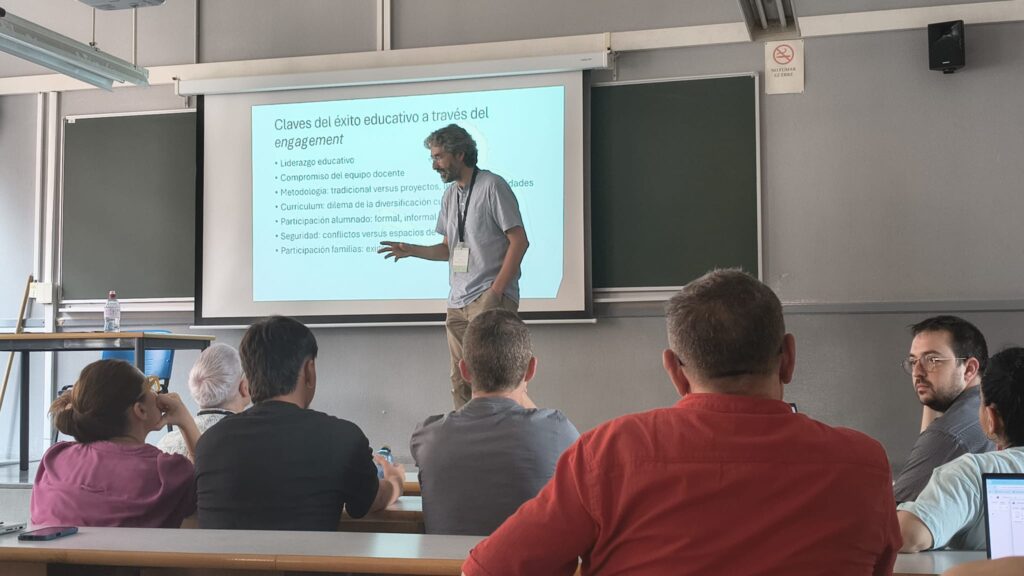
Rafael Merino, researcher at the Universitat Autònoma de Barcelona (UAB), presented the communication “Social Inequalities and School Engagement: Narratives of Social Actors in Nine Spanish Schools” at the XVI Spanish Congress of Sociology, within the Working Group on the Sociology of Education (GT 13). The study, co-authored with Eva Jové, Maribel Garcia, and Helena Troiano, explores how schools promote student engagement and address educational inequalities across different social contexts.
The presentation showcased the Spanish qualitative case study developed within the Horizon Europe project LINEup (Longitudinal Data for INequalities in Education), which brings together partners from six European countries (France, Germany, Greece, Italy, Portugal and Spain) to investigate educational inequalities through longitudinal data and qualitative research.
School engagement has become a key concept in educational research due to its close relationship with students’ academic achievement, wellbeing and educational trajectories. Within LINEup, the Spanish qualitative case study explores how students, families and teachers perceive and experience school engagement, educational inclusion and school rejection across different school contexts. By giving voice to those directly involved in everyday school life, the research complements existing quantitative evidence and provides a deeper understanding of the mechanisms that can help reduce educational inequalities.
The research is based on 24 focus groups conducted in eight public schools across different regions of Spain, including Asturias, Madrid, the Basque Country, and Aragón. Schools were selected according to educational level, territorial context, social composition, and academic performance, allowing researchers to compare diverse educational settings. The study includes primary, lower secondary, and upper secondary schools with varying levels of social complexity and educational outcomes.
During the presentation, the researchers highlighted the project’s main objective: to identify the mechanisms through which schools foster student engagement and mitigate educational inequalities. Special attention is given to understanding which interventions help improve learning outcomes, reduce disparities, and prevent early school leaving.
The study confirms that social and territorial inequalities continue to influence levels of student engagement. At the same time, the ongoing analysis is expected to identify examples of schools operating in challenging contexts that have successfully enhanced student engagement. Through the narratives of students, teachers, and families, the project aims to uncover practices and strategies that could be transferred to other schools facing similar challenges.
The findings from the Spanish case study will contribute to LINEup’s cross-country qualitative analysis, helping identify practices that can inform more equitable education policies across Europe. By focusing on the voices of educational communities, the study offers a deeper understanding of how engagement can be promoted as a pathway to improved opportunities and reduced educational inequality.