
On May 20-22, the LINEup project was presented at the RC28 Spring Meeting hosted by the University Pablo de Olavide in Seville, Spain. Within this international framework, two developments of the Mapping Report were presented: a new working paper, and the LINEup Education Data Explorer.
The RC28 Spring Meeting 2026 “Addressing Social Inequalities in the Global North and South”, as one of the most attended academic meetings in sociology and stratification processes, is proposed as a space for dialogue, collaboration, and critical reflection on one of the most urgent problems in our contemporary societies: social inequality. This year, particular attention was devoted to educational inequalities, with more than 15 parallel sessions on the topic and many international researchers presenting new findings and empirical evidence, including several researchers from the LINEup consortium. Sessions on education covered topics such as inequalities and its reproduction, schools, knowledge and social engagement, stratification processes, intergenerational mobility, and labor market outcomes.
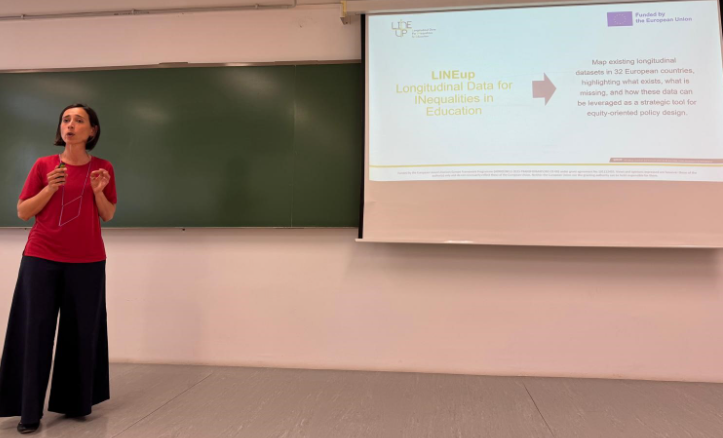
During the session “Education, Knowledge, and social engagement”, chaired by Martin Neugebauer, professor at PHKA, one the LINEup partners, Veronica Mobilio, presented a working paper titled “Unequal data, unequal knowledge: how longitudinal data infrastructures shape comparative research on educational inequalities in Europe”. The paper, coauthored by Gianluca Argentin, Martin Neugebauer, and Emmanuele Pavolini, builds on the LINEup mapping of longitudinal datasets on educational outcomes across 32 European countries.
The paper develops an exploratory typology to assess the analytical potential of longitudinal education datasets for the study of educational inequalities. The typology classifies datasets along two key dimensions: data accessibility — open, restricted, or closed — and sample coverage — national, sub-national, or ad hoc. Together, these dimensions capture two major constraints for comparative longitudinal research: the extent to which findings can be generalised and the extent to which researchers can realistically access and use the data.
In addition, the paper also proposes a synthetic index based on six desirable dataset features related to the richness of the available information, including student- and household-level variables, school- and teacher-level information, multiple achievement domains, different types of assessments, long observation periods, and coverage across both primary and secondary education. Early findings suggest that national datasets tend to display the strongest analytical potential, while sub-national and ad hoc datasets are more heterogeneous and often less suited to cross-country comparison. Overall, the paper argues that Europe’s longitudinal data landscape is promising but uneven, highlighting a broader implication: inequalities in educational research are also shaped by inequalities in data infrastructures themselves.
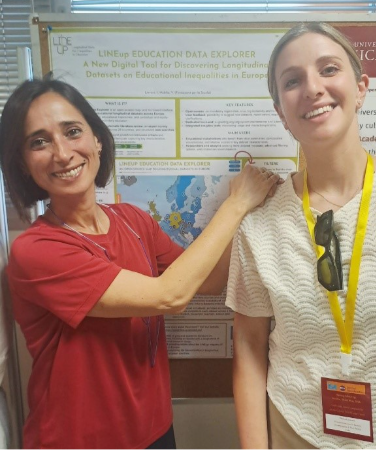
During the poster session, Ilaria Lievore, who also chaired the session “Educational inequalities and stratification processes”, presented a poster titled “LINEup Education Data Explorer: A New Digital Tool for Discovering Longitudinal Datasets on Educational Inequalities in Europe”. The poster presented the LINEup Education Data Explorer, an open-access map- and list-based interface providing access to metadata on the 103 national, regional, and local longitudinal datasets tracking student learning outcomes over time in school education (ISCED 1, 2, 3) identified through the mapping activity.
The Explorer focuses on academic achievement and basic skills, educational trajectories, and contextual and equity-relevant information. The poster explored the features of the LINEup Explorer, showing how to navigate the interface and how to use filters for detecting datasets with specific characteristics, such as country, type of data, focus, accessibility, type of skills measured, variables included, and so on. The Explorer is intended for researchers, policymakers, educators, and analysts, and it allows to explore dataset infrastructure and contents and to find the right longitudinal data to investigate educational inequalities and long-term learning outcomes.

As the project approaches its end, more outputs are following! If you want to stay in touch with the LINEup project updates, subscribe to the newsletter. In our website, you can find the latest feasibility study report on the harmonisation of longitudinal educational datasets, and our cartoon videos exploring how educational inequalities are experienced in everyday school life.
.